
Home/Resources/Case studies/Chelmsford PSB-E
Town of Chelmsford, MA — Public school building electrification roadmap study
What does it cost to electrify nine school facilities? What if we just keep them running as they are? How much would that cost? What is the difference in utility costs? How about maintenance? The Town of Chelmsford wanted answers.
That is not a problem with a simple or straightforward answer. Creating a timeline for electrification is not going to answer that question either. In fact, the Town already had an electrification roadmap with a recommended timeline.
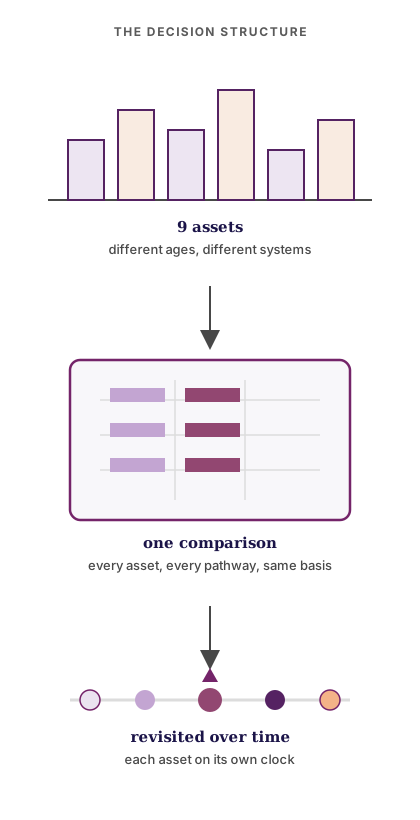
In our line of work, we call this a decision-support problem. Multiple assets, competing priorities, costs and variables that change over time — a lot of moving parts that cannot be weighed in isolation. To make progress, The Town needed to establish a common basis so that decision-makers with different mandates could come together, evaluate different scenarios, and figure out what's best for their competing needs and constraints.
The Chelmsford Department of Public Works (DPW) put that question out to competitive bid. At ENHUEX, we do not recommend one pathway or the other. We provide the basis so decision-makers can make informed decisions on the calls they have to make — when those decisions have real consequences. We build the engineering record behind those decisions.
Context
The Town of Chelmsford operates nine public school facilities, which include elementary, middle, and high school buildings as well as a central administration building, totaling 826,048 square feet. The buildings were originally constructed from 1955 to 1974. Heating, ventilation, and air conditioning (HVAC) and other systems saw many renovations over the years, resulting in a portfolio of buildings with a complex mix of equipment inventories, histories, and remaining service life. For instance, in several buildings, the electrical switchgear — the gear that distributes power in the building — is still original to the structure, yet many of them have rooftop solar systems installed within the last couple of decades, with roofs of different ages.
Electrifying such a complex building portfolio is not a straightforward problem, whether we talk in terms of engineering design, lifecycle planning, or board decision-making. Each building has its own unique history, conditions, and technology constraints, not to mention its own situation for use, schedule, and conversion timing.
In May 2024, the DPW issued a request for proposals (RFP) for a school-building electrification roadmap study — a detailed analysis to evaluate their options for working through this exact challenge.
The RFP framed the work against the Town's stated commitment to eliminate carbon emissions by 2050, and sought solutions that would help them evaluate options to move off fossil-fuel systems, compare capital and operating costs through 2050, and give the boards a plan to sequence work building by building. View the RFP for full context →
Scope
The study modeled two pathways across a 28-year horizon (2024–2051): full building electrification, and continued operation on existing equipment. One standardized cost method put all nine buildings on the same basis — capital, utility, and maintenance side by side.
No single number is certain out to 2051. Utility rates move. Equipment costs move. Every major output carries a documented sensitivity to the assumption driving it, so the comparison can be re-read if those assumptions change.
Deliverable
The Town received a 28-year lifecycle cost framework for both pathways across all nine buildings; a phased timeline so facilities can be sequenced independently; and full assumption documentation with sensitivity reporting — as an executive-ready report for board and committee review.
The complete study — methodology, assumption documentation, and facility-level results — is publicly available through the Town of Chelmsford. Read the published report →
Outcome
The Town did not get a recommendation from ENHUEX on which pathway to take. Instead, they got a documented basis to make decisions on the two pathways, with assumptions stated in full, so decision-makers and the people they answer to can put all their options on the table and hash out what fits their mandates, budgets, and constraints.
The Chelmsford DPW got a framework it could take into public project updates with stakeholders: the same numbers, outside the report binder, in front of the people who have to act on them. View a sample DPW presentation using results from the study →
The same material showed up in School Committee discussion of electrification costs (August 2025) — the board working the pathway tradeoffs in open session. Watch the meeting →
That is exactly what this kind of decision-support framework is built for. A DPW sequencing work across the portfolio, a facilities lead comparing buildings that do not look alike, a school committee or select board that has to stand behind a multi-year pathway call. One method across the entire portfolio. A record that holds up at more than one table.
In June 2026, the Town of Chelmsford issued a new RFP for its remaining municipal buildings and attached the ENHUEX-delivered final report from this study as a reference — proof the method was useful enough to carry forward beyond the school portfolio. View the follow-on RFP →
This engagement is an example of Pre-Deployment Planning. For the municipal / DPW product shape — what the study answers and FAQ — see Building Electrification Roadmaps.